Transition Finance
Retail and Commercial Bank
Key Lessons Learned:
A credible transition finance framework needs to include a comprehensive, technically robust assessment that includes, benchmarking against peers, assessing criteria in detail, and identifying clear points of differentiation so informed decisions can be made. Organisations can then build guidance that is practical, aligned with real‑world business needs and decarbonisation pathways.
Challenge
A bank wanted to develop a Transition Finance Framework that provided structured guidance for directing financial investments towards eligible categories as they decarbonise, while remaining aligned with climate goals and wider sustainable‑development objectives. We were asked to benchmark the proposed framework against market peers and conduct a technical assessment of the criteria to identify areas of differentiation and ensure the framework was both credible and practically implementable.
Solution
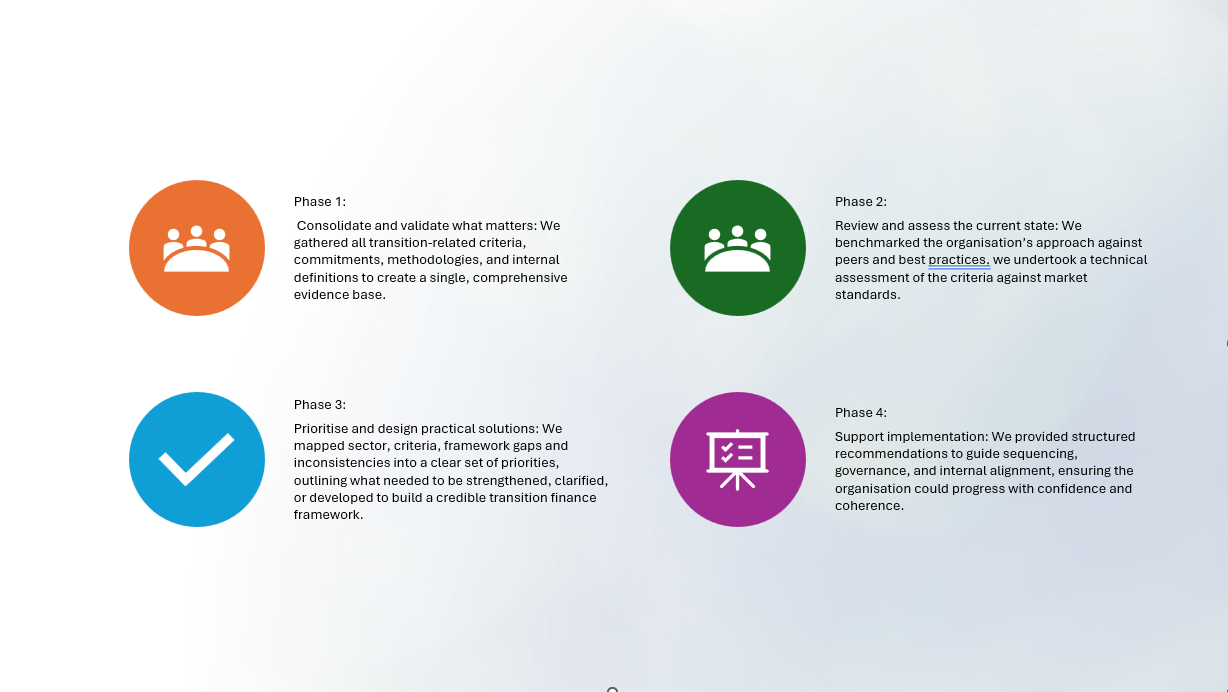
We applied our four‑stage framework to bring clarity and structure to a complex landscape.
Phase 1: Consolidate and validate what matters: We gathered all transition‑related criteria, commitments, methodologies, and internal definitions to create a single, comprehensive evidence base.
Phase 2: Review and assess the current state: We benchmarked the organisation’s approach against peers and best practices, we undertook a technical assessment of the criteria against market standards.
Phase 3: Prioritise and design practical solutions: We mapped sector, criteria, framework gaps and inconsistencies into a clear set of priorities, outlining what needed to be strengthened, clarified, or developed to build a credible transition finance framework.
Phase 4: Support implementation: We provided structured recommendations to guide sequencing, governance, and internal alignment, ensuring the organisation could progress with confidence and coherence.
Outcome
The organisation gained a clear, consolidated view of its transition finance framework maturity. This enabled leadership to identify the most important areas to strengthen, align internal teams around a shared narrative, and build a more credible, investor‑ready transition‑finance strategy. The work also created a foundation for future impact reporting, governance, and disclosures.