ISSB / IFRS Global Reporting Tool
Global Healthcare
Key Lessons Learned:
Start with the IFRS standards as the single source of truth, then layer on regional or country‑specific variations where needed. Map the underlying disclosures, include timelines, and any phasing clearly. Describe requirements in plain English so local teams can translate.
Challenge
A global firm needed a user‑friendly tool to help regional teams draft ISSB‑compliant sustainability disclosures. The core challenge was information fragmentation: relevant information was spread across multiple corporate documents, and each region / country introduced its own interpretation of the standards. This created inconsistency, duplication, and a high risk of non‑compliance. We were asked to create a structured, accessible way to bring coherence and standardisation to the disclosures while supporting local reporting variations.
Solution
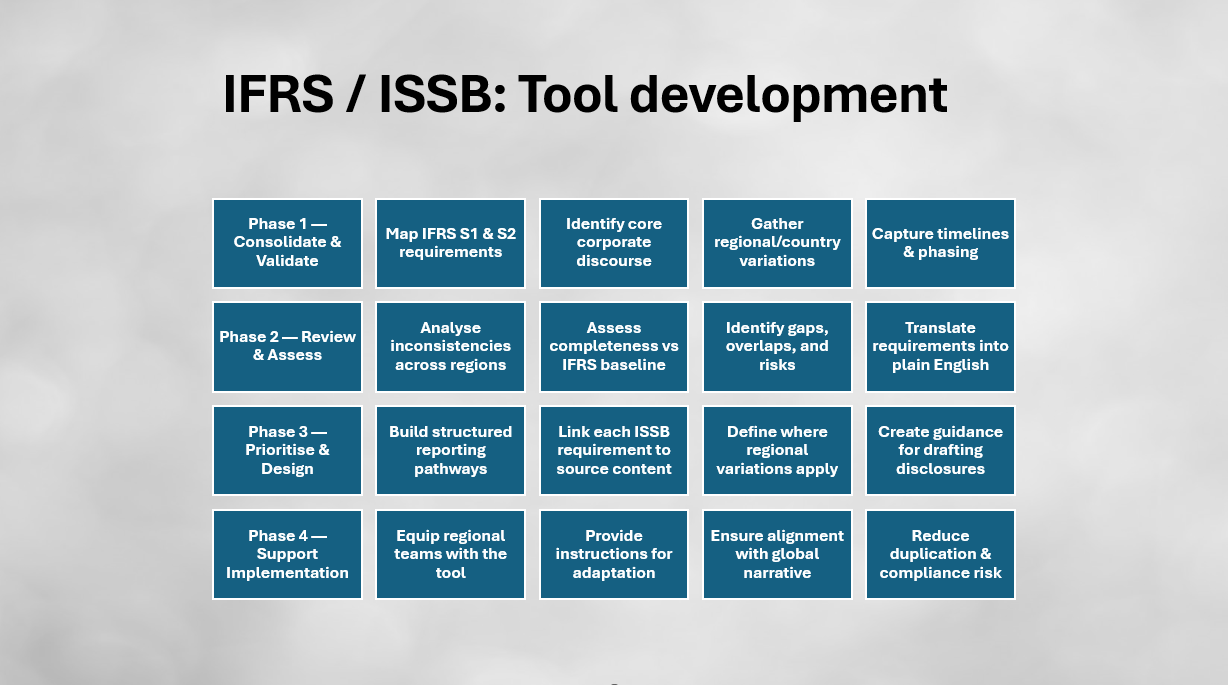
We applied our four‑stage framework to design a practical, scalable reporting tool that brought clarity and consistency to a complex global landscape.
Phase 1: Consolidate and validate what matters: We mapped all relevant corporate narratives, data points, policies, and existing disclosures to the IFRS S1 and S2 requirements.
Phase 2: Review and assess the current state: We analysed how regions were interpreting and adapting the discourse, identifying inconsistencies, gaps, and areas where timelines or phased requirements differed.
Phase 3: Prioritise and design practical solutions: We built a structured tool that linked each ISSB requirement to its source content, highlighted regional variations, and provided plain‑English guidance on how to draft compliant disclosures.
Phase 4: Support implementation: We equipped the central team to use the tool effectively, ensuring they could communicate to local teams how to produce aligned, compliant reports without reinventing content or deviating from the core corporate narrative.
Outcome
Regional teams gained a clear, efficient, and consistent way to produce ISSB‑compliant disclosures. The tool reduced duplication, strengthened alignment across countries, and ensured that all reporting reflected a unified corporate narrative anchored in IFRS standards. It also lowered compliance risk, improved reporting quality, and created a scalable model that can evolve as ISSB requirements mature and regional expectations shift.